
For avid shroom enthusiasts, the search for a “heavy hitter” never really ends. If you’ve been hearing the name Blue Meanie everywhere, it’s because this variety has a reputation for fast-onset, intense effects and high potency compared to many other psilocybin mushrooms.
One quick note before we jump in: “Blue Meanie” can refer to different mushrooms depending on the seller and region. There is a cubensis variety labeled ‘Blue Meanie’, but this name is widely believed to be a vendor misnomer. There are many psilocybin varieties, each with unique properties and effects—strains like Albino Penis Envy, Golden Teacher, and Blue Meanies are just a few examples of the diversity within psilocybin mushrooms. Different strains of psilocybin mushrooms can contain varying amounts of psilocybin, psilocin, and other analogs, which means their effects can differ due to their distinct alkaloid profiles. In this article, we’re talking about Panaeolus cyanescens (often called “Pan Cyan”), which is widely associated with the Blue Meanie nickname. In regions like New Zealand, the name “blue meanies” can refer to other local blue-tinted species like Psilocybe weraroa.
To an untrained eye, Blue Meanie mushrooms can look “off” because of their blue staining — but that blue color is typically a bruising reaction, not spoilage. (Mold looks very different — more on that below.)
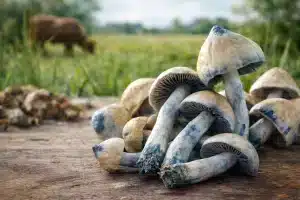
What are Blue Meanie mushrooms?
Blue Meanie mushrooms are most commonly identified as Panaeolus cyanescens, a psychoactive mushroom species in the Bolbitiaceae family. They’re known for bruising blue when handled, which is where the “blue” part of the name comes from. The cap is 1.5–4 centimeters across, dry, and initially hemispheric, expanding to campanulate or convex as it matures. Young caps start out light brown and fade to off-white or light gray at maturity, sometimes showing yellowish or brownish tones, which helps with visual identification.
Panaeolus cyanescens is considered one of the most potent hallucinogenic mushrooms described in academic research, prized for its strong psychedelic properties and hallucinogenic effects.
And the “meanie”? That’s the reputation: many users describe them as noticeably stronger than what they expected from more common species.
Despite their unassuming appearance, Blue Meanies are among the most powerful psilocybin mushrooms. They produce small to medium-sized mushrooms with yellowish or brownish tones, making them easy to overlook for beginners. But don’t let their modest looks fool you—these mushrooms are anything but ordinary.
How to recognize Blue Meanies (education, not foraging advice)
Blue Meanies have a few commonly described traits, but identification in the wild is not beginner-friendly and misidentification can be dangerous. Treat this section as general education — not a DIY field guide.
Typical descriptions include:
-
A small cap (often light brown when young, fading to pale gray/off-white as it matures) that can crack in dry weather, with developing cracks sometimes appearing on the cap surface as it dries.
-
Gill faces with a mottled appearance, broadly adnate to adnexed, starting out gray and turning black as the spores mature. The gills darken as spores mature, often described as mottled, with a black spore print that is jet black. Under the microscope, the spores show a distinct germ pore and other microscopic features.
-
A slender stem (stipe) that is 6–12 cm long by 2 to 4 mm thick, equal to slightly enlarged at the base, and stains somewhat blue where handled or bruised.
-
A “floury” (farinaceous) smell is often reported.
Microscopic features, such as the presence of a germ pore, are important for accurate identification.
Here is a more in depth look at identifying blue meanie mushrooms.
Where do Blue Meanie mushrooms grow?
The habitat Panaeolus cyanescens prefers is primarily coprophilous (dung-inhabiting), thriving on animal dung in warm, humid climates—most commonly in tropical and subtropical regions. As a coprophilous species, it is frequently reported in pastures and grassy fields where grazing animals are present, and sightings often increase after periods of rain or heavy moisture.
Panaeolus cyanescens occurs in both the Neotropics and Paleotropics, highlighting its wide geographic distribution across large warm-climate zones on multiple continents. Blue Meanies mushrooms have been found in various regions including Vietnam, Africa, Australia, the Caribbean, and the United States, with additional reported occurrences in parts of Southeast Asia, Oceania, and the Americas.
Can Blue Meanies be grown indoors?
Yes — they can be cultivated indoors under controlled conditions, and when grown intentionally they’re often referred to as “Pan Cyan.”
That said, they’re widely regarded as more demanding and less forgiving than more commonly cultivated psilocybin mushrooms. Even in scientific and technical contexts, indoor cultivation of psilocybin-containing mushrooms is often described as non-trivial, with only a limited set being routinely grown under controlled conditions.
In practical terms (high level):
-
They’re associated with very specific habitat conditions in nature (warmth + humidity + nutrient context), so recreating that reliably is harder than with “beginner-friendly” species.
-
Growers often describe them as finicky—meaning small environmental swings can lead to poor results. (That’s not a rule, just a common experience.)
Potency: why Blue Meanies have a “strong” reputation
When people call Blue Meanies “potent,” they’re usually talking about higher levels of psilocybin + psilocin compared to many other commonly sold mushrooms — and lab testing has found very high total alkaloid content in some samples, though potency can vary widely by genetics, growing conditions, and handling. Panaeolus cyanescens contains psilocybin at approximately 2.5% and psilocin at about 1.194%.
One forensic paper discussing seized samples notes that Panaeolus cyanescens can show extraordinarily high concentrations and reports total alkaloids around ~3× higher than Psilocybe cubensis in the samples they analyzed. These forensic studies often focus on the detection of drugs in seized samples. Academic research on the chemical composition and psychoactive properties laussmann, as well as other researchers, have documented a significant presence of serotonin and the possibly psychotropic indole alkaloid baeocystin in this species.
Translation: these aren’t the best choice for “my first ever experience” unless someone is being extremely conservative and knows what they’re doing.
Recommended dosage
Because Blue Meanies have a reputation for high potency, the safest advice is:
-
Start low
-
Avoid mixing substances
-
Give it time
-
Choose a calm, familiar setting
-
Don’t go solo if you’re inexperienced
Lastly, your environment matters. Before consuming blue meanies, you must ensure you are in a safe enough setting to have the best experience and avoid a bad trip.
Experts state that you should have a significant presence of someone trustworthy because consuming blue meanies alone is not the best practice; you never know how your system may react to these shrooms, so having company with clarity around is important. It’s worth taking a look at our beginner’s guide to magic mushrooms for tips on consuming these mushrooms in a safe and prepared manner.
The Blue Meanie Experience
So, what can you expect from a Blue Meanie trip? Here are some common effects:
-
Auditory and Visual Hallucinations: Colors and sounds may become more vivid and intense.
-
Euphoria: Many users report feelings of happiness, oneness with the universe, and deep contentment.
-
Enhanced Introspection: Blue Meanies can lead to profound self-awareness and epiphanies.
-
Physical Effects: You may experience changes in body temperature, an increased heart rate, and dilated pupils.
Compounds within Panaeolus cyanescens can enhance mood, may help alleviate symptoms of anxiety, and improve cognitive flexibility. Blue Meanies mushrooms have also held cultural significance in many societies, being used in spiritual rituals and traditional ceremonies, and were historically revered for their ability to facilitate transcendental experiences.
Keep in mind that the effects can vary widely depending on your tolerance, dosage, and environment.
Blue bruising explained (and why it’s not the same as mold)
Blue staining in “magic mushrooms” is linked to a biochemical reaction that happens when the mushroom tissue is damaged. Research has shown that injury can trigger enzymatic steps that convert psilocybin into psilocin and then oxidize it into blue-colored compounds.
Important takeaway:
-
Bruising tends to look like smooth blue staining in the tissue
-
Mold tends to look fuzzy/powdery/webby, often paired with moisture and an “off” smell
A deeper dive into the bruising vs mold subject can be found in our article describing how long magic mushrooms last.
Introducing Code Blue: A Potent Hybrid
If you thought Blue Meanies were powerful, wait until you meet Code Blue—a hybrid strain that combines the genetics of Melmac and Blue Meanie mushrooms.
The effects of psilocybin mushrooms can vary across strains due to the different types of alkaloids they contain, and there are many psilocybin varieties with unique properties. For example, Psilocybe Cubensis is one of the most well-known strains, commonly found in the southern and central United States. Psilocybe Semilanceata, also known as liberty caps, is a smaller strain prevalent in the Pacific Northwest of the US and Canada, recognized for its distinctive conical shape and potent effects. Psilocybe Cyanescens, or wavy caps, are another potent variety found in the Pacific West region of North America. Other notable strains include the Amazonian strain, known for its potency and intense visual effects; the B+ strain, famous for its large, meaty caps, thick stems, and strong sense of euphoria; and the Penis Envy strain, which stands out for its unique appearance and intense visual hallucinations.
This crossbreed takes potency to the next level, offering an even more intense psychedelic experience. Code Blue inherits the best traits of both parent strains: the deep introspection and euphoria of Blue Meanies, paired with the robust, long-lasting effects of Melmac.
Known for its high psilocybin content, Code Blue is not for the faint of heart. It’s recommended only for experienced users who are familiar with the effects of potent psychedelics.
As with any powerful strain, start with a microdose and ensure you’re in a safe, comfortable setting to fully appreciate the profound journey Code Blue can offer.
Cultural Significance of Blue Meanies
Blue Meanie mushrooms, commonly referred to as Panaeolus cyanescens, have a rich cultural legacy that extends far beyond their biological properties. Throughout history, these psilocybin mushrooms have played a significant role in traditional ceremonies and spiritual practices, especially in regions where they naturally thrive, such as the Neotropics and Paleotropics. The striking blue staining reaction—an iconic feature of this species—has long captured the imagination of those who encounter it, often being interpreted as a sign of the mushroom’s potent psychoactive properties.
In many cultures, the use of Panaeolus cyanescens has been intertwined with rituals aimed at healing, divination, and connecting with the spiritual world. The profound psychedelic experiences induced by these mushrooms have been sought after for personal insight, emotional release, and a deeper understanding of consciousness. Today, Blue Meanies continue to hold a special place in the world of psychoactive plants, with modern enthusiasts exploring their effects for self-discovery, creativity, and mental wellness.
By appreciating the cultural significance of Blue Meanies, we recognize that their value is not just in their chemistry, but also in their enduring influence on human experience and tradition. Whether used in ancient rites or contemporary journeys, these psilocybin mushrooms remain a powerful bridge between nature, mind, and culture.
Potential therapeutic research
Research into (the compound, not a specific strain) is exploring potential applications in areas like depression and OCD in controlled clinical settings. The legal status of psilocybin remains complex, with significant variation across different regions, reflecting broader societal attitudes towards psychedelic substances. As societal norms continue to evolve, there is an increasing conversation around the potential decriminalization or medicalization of psychedelic substances. This is not the same thing as self-treating at home, and results can depend heavily on context, screening, and professional support.
Conservation Status and Environmental Impact
While Panaeolus cyanescens is widely known for its psychoactive properties and popularity among those seeking psilocybin mushrooms, its conservation status is less well understood. As a dung-inhabiting species, this mushroom relies on specific environmental conditions—such as the presence of grazing animals and healthy grassland ecosystems—to thrive. Unfortunately, human activities like habitat destruction, pollution, and climate change can negatively affect these delicate environments, potentially impacting wild populations of Panaeolus cyanescens and other fungi.
The growing demand for psilocybin mushrooms, both for therapeutic research and recreational use, also raises concerns about over-harvesting from natural habitats. While modern commercially cultivated strains can help reduce pressure on wild populations, it’s important to consider the broader ecological role that these fungi play. Fungi like Panaeolus cyanescens contribute to nutrient cycling and ecosystem health, making their protection vital for biodiversity.
Ongoing research is essential to better understand how environmental changes affect these mushrooms and to develop strategies that protect their habitats. Sustainable practices, responsible sourcing, and increased awareness can help ensure that Panaeolus cyanescens and other valuable species continue to enrich both our ecosystems and our cultural heritage for generations to come.
Legality and Considerations
The cultivation, identification, possession, or use of Blue Meanie mushrooms may be illegal in some jurisdictions. It is important to research and follow local laws and regulations regarding Blue Meanie mushrooms, as psilocybin is a controlled substance in many jurisdictions.
Misidentification of blue meanies with poisonous species can lead to severe illness, organ damage, or death. Common side effects of blue meanies include nausea, vomiting, and increased heart rate.
Conclusion
Blue Meanie mushrooms (Panaeolus cyanescens) have earned a reputation for being fast and intense, and that’s exactly why they deserve respect. If you’re exploring them, prioritize a conservative approach, a safe setting, and good preparation — your future self will thank you.


You have a great website, and the content is really informative. Thank you for providing such information. we believe that the appreciation for information grows exponentially. Our dedication to stay current ensures that we are always exposed to latest insights, trends, and breakthroughs.