Microdosing magic mushrooms has moved from Silicon Valley whispers to mainstream wellness conversations in just over a decade. If you’ve heard friends, podcasters, or wellness influencers talk about taking tiny amounts of psilocybin to sharpen focus or lift mood, you’re not alone—interest in this practice has surged across Canada and beyond.
But what does microdosing actually involve, and does it live up to the hype? This guide breaks down everything you need to know about microdosing psilocybin mushrooms in 2026, from the science and dosing basics to safety considerations and Canadian legal realities.
This pillar page provides a broad foundation. For deeper dives, we’ve created detailed guides on microdosing below:
- How to Microdose Mushrooms: Step-by-Step for Beginners — A step by step guide to measuring doses, titration, and practical daily routines
- Microdosing Protocols: Schedules, Goals, and Tracking Results — Detailing multiple evidence-informed schedules and how to choose one based on your goals
- Microdose Capsules vs Gummies vs Dried Mushrooms — Helping you decide which format fits your lifestyle
- Microdose Safety – Do’s and don’t to help microdose safely and effectively
What Is Microdosing Magic Mushrooms?
Microdosing refers to the repeated self-administration of psilocybin mushrooms at sub-perceptual doses—amounts small enough that they don’t produce the hallucinations, visual distortions, or altered states associated with a full psychedelic experience. The typical microdose ranges from 0.05 to 0.3 grams of dried Psilocybe cubensis, taken several times per week according to a structured schedule.
The key word here is “sub-perceptual.” A properly calibrated microdose should be subtle enough that you can go about your day—working, driving, parenting—without impairment. You shouldn’t feel “high” or experience any conscious visual perception changes. If you notice significant shifts in perception, the dose was likely too large.
This stands in clear contrast to full psychedelic “macrodoses,” which typically involve 2 to 3.5 grams of dried psychedelic mushrooms and produce profound alterations in consciousness lasting 4 to 6 hours. Between these extremes sits what some call the “museum dose” (roughly 0.5 to 1 gram)—enough to feel mild effects while still being able to navigate public spaces like an art gallery.
Canada Shrooms is a Canadian online dispensary specializing in lab-tested psilocybin products for adults. This article is an educational overview intended to help you make informed decisions—it is not medical advice. Research on microdosing is still emerging, and placebo-controlled studies from 2022-2023 using 0.5 gram doses of Psilocybe cubensis have shown mixed results. Ample anecdotal evidence suggests benefits, but the science remains unsettled.
How Microdosing Psilocybin Is Thought to Work
When you consume psilocybin mushrooms, your body converts psilocybin into psilocin—the compound actually responsible for psychedelic effects. Psilocin interacts primarily with 5-HT2A serotonin receptors in the brain, the same receptors targeted by other classic psychedelic drugs like lysergic acid diethylamide (LSD).
At full doses, this interaction produces dramatic changes in brain network connectivity. Functional magnetic resonance imaging studies have shown that psilocybin modulates the default mode network—the brain system associated with self-referential thinking and the sense of ego. This disruption may explain the feelings of ego dissolution and interconnectedness reported during intense trips.
But what happens at very low dose levels? Here, the picture gets murkier. Modern neuroimaging and EEG research has attempted to detect measurable changes at microdose ranges. Some double-blind studies found decreased theta-band power and broadband spectral power reductions with 0.5 gram doses, but these neurological shifts didn’t translate into robust improvements in creativity, cognitive function, or mental health scores after proper statistical correction.
A critical challenge in psychedelic research is expectation. In several placebo-controlled trials, participants correctly identified whether they had taken psilocybin in approximately 70-75% of dosing weeks—a phenomenon called “unblinding.” When people know or suspect they’ve taken the active dose, reported effects increase dramatically. This creates a significant placebo effect confound that researchers are still working to address.
The local global paradigm combined with EEG analysis has been used in some studies to assess cognitive function and perception. These approaches help scientists estimate statistical power and facilitate direct visual comparison of neural responses, but relatively few human studies have been completed with the rigor needed to draw firm conclusions about microdosing’s mechanisms at the physiological and neurobiological levels.
Why People Microdose Mushrooms
The motivations driving people to microdose are as varied as the people themselves, but certain themes emerge consistently in surveys of microdosers across Canada and globally.
Many people turn to microdosing hoping to support their mental health—managing low-level anxiety, lifting persistent low mood, or simply feeling more emotionally resilient during stressful periods. Others are drawn by promises of enhanced focus and productivity, seeking an edge in creative or knowledge work without the jitters of caffeine or the side effects of pharmaceutical stimulants. Creativity enhancement remains a major draw, with early advocates in tech and artistic communities reporting substantial positive effects on divergent and convergent thinking, problem solving abilities, and the ability to see connections between disparate ideas.
Some microdosers report that the practice helps them positively affect empathy and deepen their relationships. Others use it as part of a broader effort to break unhelpful habits—attempting to reduce smoking, address alcohol use disorder patterns, or shift away from other behaviors they want to change.
It’s important to contrast these anecdotal reports with controlled trial outcomes. While full-dose psilocybin-assisted therapy has shown genuine promise in clinical trials for treatment resistant depression, post traumatic stress disorder, and addiction (research from centers like Johns Hopkins has demonstrated significant improvements in these areas), microdose research presents significantly positive impact in self-reports but far less conclusive results when proper placebo controls are applied.
Many Canada Shrooms customers aren’t seeking intense psychedelic experiences. Instead, they’re curious about gentle, incremental mental wellness support while maintaining full functionality in their daily lives. This is a legitimate exploratory approach—but it’s worth being honest that psilocybin is not an approved medical treatment for mental health conditions or mental health disorders in Canada. Anyone seeking diagnosis and treatment for a mental health concern should speak with a healthcare professional.
Microdosing Dosage Basics and Typical Ranges
Understanding dosage is fundamental to microdosing mushrooms safely and effectively. The commonly cited range for dried Psilocybe cubensis falls between 0.05 and 0.3 grams (50 to 300 milligrams), depending on individual sensitivity and the potency of the specific mushroom batch.
Some research trials have used 0.5 grams as a “microdose,” but this sits at the very upper boundary and crosses into perceptible territory for many people. At this level, you might notice mild mood shifts, slight visual changes in color saturation, or a gentle sense of being “different”—technically a museum dose rather than a true microdose.
Most beginners in 2025 start conservatively, between 0.05 and 0.1 grams, to test their sensitivity before gradually approaching higher amounts like 0.2 or 0.25 grams. The principle of “start low and go slow” applies strongly here.
One critical variable is potency. Psilocybin content varies significantly by mushroom strain (Psilocybe cubensis versus Psilocybe semilanceata, for instance) and even between batches of the same strain grown under different conditions. This variability is why Canada Shrooms emphasizes lab testing and standardized products—capsules and gummies with consistent psilocybin content per unit make dosing far more predictable than eyeballing dried mushrooms on a kitchen scale.
| Dose Category | Dried Psilocybe cubensis | Expected Experience |
|---|---|---|
| Microdose | 0.05–0.3 g | Sub-perceptual; no impairment |
| Museum Dose | 0.5–1 g | Mild mood lift, subtle perception shifts |
| Moderate Dose | 1.5–2.5 g | Noticeable psychedelic effects |
| Macrodose | 3–5+ g | Intense psychedelic experience |
Our step-by-step “how to microdose” guide offer more detailed instructions for getting your dose and dosing schedules dialed in.
Microdosing Protocols and Schedules
Microdosing isn’t typically done daily. Instead, practitioners follow structured schedules designed to prevent tolerance buildup and allow “integration days” for processing any subtle effects.
The most famous protocol was popularized in the early 2010s: one day on, two days off. Under this approach, you might take a microdose on Monday, skip Tuesday and Wednesday, dose again Thursday, and so on. This schedule has remained popular because it balances consistent exposure with sufficient breaks to maintain sensitivity.
More recently, some microdosers have experimented with four days on, three days off schedules, or even lower-frequency approaches like dosing just once or twice per week. Surveys of over 4,000 microdosers found that more than 50% also engage in “stacking”—combining psilocybin with other substances like lion’s mane mushroom or niacin for potential synergistic benefits, particularly around neurogenesis and cognitive support.
Tracking is essential regardless of which protocol you choose. Keep a simple journal noting your dose amount, time of day, mood, sleep quality, productivity, and any other observations. Patterns often emerge only after several weeks of consistent logging. Without data, you’re guessing.
Different goals may call for different schedules. Someone focused on creative projects might dose on specific workdays; someone addressing mood patterns might prefer evenly spaced intervals. Controlled studies often used fixed weekly patterns—dosing on Wednesday and Friday, for example—to collect standardized data, though these schedules may or may not match real-world best practices.
Our dedicated “microdose protocols” article explores these options in depth, helping you choose a schedule aligned with your specific intentions.
Forms of Microdosing: Dried Mushrooms, Capsules, and Gummies
Microdosing can be done with carefully weighed dried mushrooms, pre-measured capsules, or edible formats like gummies and chocolates. Each has distinct advantages and trade-offs.
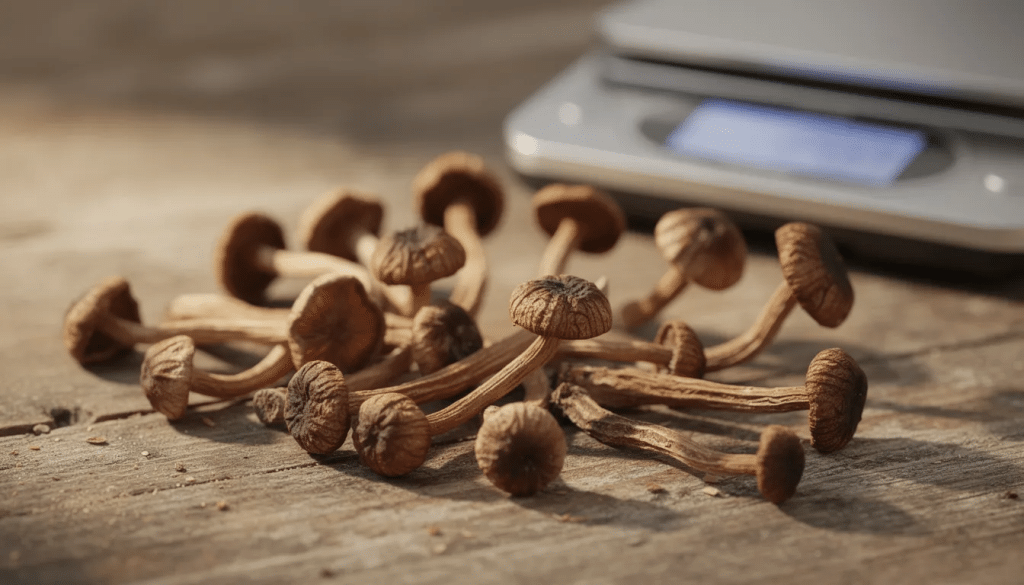
Dried mushrooms represent the traditional approach—grinding them into a powder and weighing precise amounts on a milligram scale. This method offers flexibility but introduces variability, since potency differs across the mushroom body and between specimens.
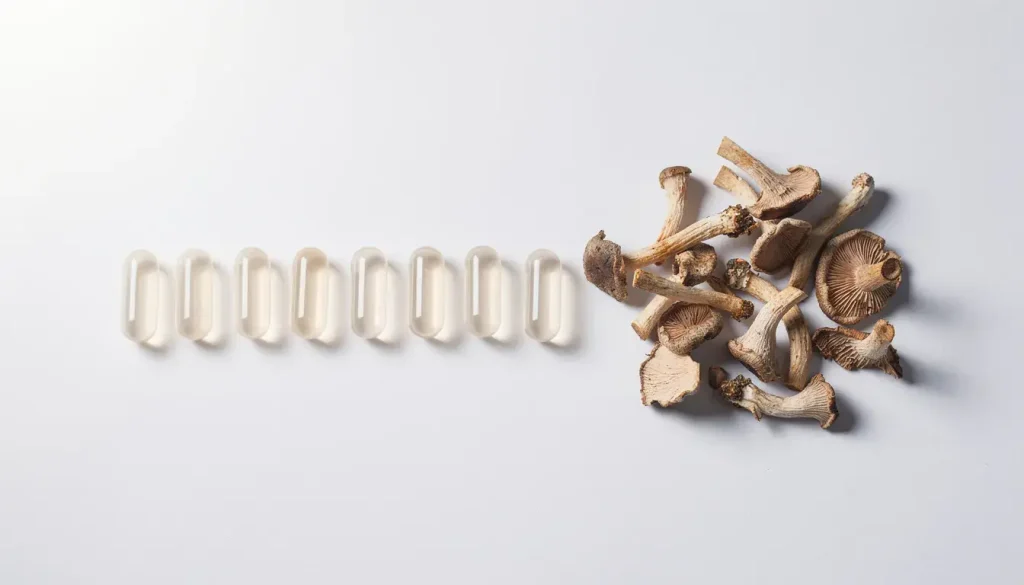
Capsules allow precise milligram-level dosing with minimal guesswork. A standardized capsule containing exactly 100 or 150 milligrams of psilocybin-containing mushroom material takes the precision burden off the user. For people who want consistency and convenience, capsules are often the preferred choice.
Gummies and edibles appeal to those who dislike the taste of dried mushrooms or want something more discreet. However, these formats require careful labeling and must be stored securely away from children and pets who might mistake them for candy.
| Format | Precision | Convenience | Taste | Discretion |
|---|---|---|---|---|
| Dried Mushrooms | Variable (requires scale) | Lower | Earthy/bitter | Moderate |
| Capsules | High (pre-measured) | High | None | High |
| Gummies/Edibles | Moderate (depends on labeling) | High | Pleasant | High |
Canada Shrooms offers lab-tested microdose capsules and edibles designed to provide consistent psilocybin content per unit. Our separate guide, “Microdose Capsules vs Gummies vs Dried Mushrooms” dives deeper into onset time, duration, convenience, and formulation differences to help you decide which format fits your lifestyle.
What the Science Says: Benefits, Limits, and Placebo
Let’s be direct about the current state of psychedelic research on microdosing: the evidence is mixed, and honest reporting requires acknowledging this reality.
Randomized, double-blind, placebo-controlled microdosing studies from 2020-2024 present significantly positive impact in some measures but fall short of confirming the dramatic benefits often claimed in anecdotal reports. A 34-person trial using 0.5 gram Psilocybe cubensis doses found that participants reported “feeling something” on active dose compared to placebo days, and EEG measurements detected decreased theta power. However, after statistical correction, researchers found no robust improvement in creativity, cognitive function, physical activity, or self-reported mental health.
The larger broadband reductions observed in EEG data and changes in logarithmic power spectral density suggest that something is happening neurologically—but these physiological changes don’t reliably translate into the enhanced mental function that microdosers seek.
Expectation and unblinding remain major confounds. In a self-blinding citizen science trial with 191 participants, break-blind rates rose significantly at higher doses, and participants who correctly guessed they’d taken the active substance reported substantially more acute effects. The perceived stress scale and negative affect scale scores improved—but largely in line with what expectation alone might produce. The alternative and null hypothesis testing in these studies often indicates moderate evidence for placebo rather than pharmacological effects.
This contrasts sharply with stronger evidence for full-dose psilocybin-assisted therapy. Landmark work from Johns Hopkins has demonstrated genuine, lasting reductions in depression and anxiety in healthy and clinical populations—particularly cancer patients facing existential distress. Clinical trials for addiction and treatment resistant depression using macrodoses under medical supervision have shown results that remain statistically significant across multiple follow-ups. But these are high-dose experiences in controlled clinical settings with psychological support, not microdoses taken at home.
The auditory local global paradigm and related assessments used in some studies to assess cognitive function—measuring responses to local and global deviants and global and local deviants in stimulus patterns—haven’t revealed consistent microdosing benefits. While some local global ERP analysis shows subtle changes, these don’t demonstrate the clear dose dependent positive effects that would confirm microdosing’s reputation.
A balanced, honest conclusion: microdosing appears safe for many healthy adults in the short term and may feel helpful subjectively, but large, long-term, rigorously controlled studies are still needed. Anyone expecting microdosing to function as a proven therapeutic intervention should temper those expectations. Treat it as an experiment in self-observation rather than a guaranteed solution.
Safety, Risks, and Who Should Avoid Microdosing
Psilocybin is a powerful psychoactive substance, and microdosing is not risk-free—even at low doses.
While serious adverse events are rare in healthy adults taking true microdoses, psychological risks exist. Some people experience increased anxiety, restlessness, mild derealization, or heightened emotional sensitivity on dosing days. A minority may feel worse rather than better, with slightly decreased positivity ratings or increased rumination. These effects underscore why tracking your experience and approaching with caution matters. Check out our Microdose Safety article for a detailed breakdown of the risks and side effects involved with psilocybin use.
Certain groups should avoid unsupervised psilocybin use entirely:
- Individuals with personal or family history of psychosis, schizophrenia, or bipolar I disorder
- Those with severe personality disorders
- People currently taking certain psychiatric medications (SSRIs, MAOIs, mood stabilizers) without medical guidance
- Pregnant or breastfeeding individuals
- Anyone experiencing a mental health crisis
The chemistry and technology Prague research teams and others have noted that chronic serotonin receptor agonism could theoretically pose long-term risks, though this remains unstudied at microdose levels. Oregon psilocybin services and other emerging regulatory frameworks are developing guidelines, but we’re still in early days.
Legal and occupational risks also deserve attention. Psilocybin is not fully legalized across Canada, and possession may conflict with workplace drug policies. Understand your local laws and employment rules before proceeding.
Practical harm reduction tips:
- Start with very low doses (0.05-0.1g) and adjust slowly
- Avoid mixing with alcohol or other substances
- Do not drive or operate heavy machinery when experimenting with new doses
- Keep all products securely stored away from children and pets
- Source from reputable suppliers who provide lab testing to avoid contaminants or misidentified toxic mushrooms
Microdosing and the Law in Canada (2025 Overview)
Psilocybin remains a controlled substance under Canadian federal law. Legal access exists through limited pathways: special exemptions granted by Health Canada, research licenses, and a small number of regulated therapeutic contexts.
Despite federal illegality, an active gray-market ecosystem operates online, including retailers like Canada Shrooms that focus on adults, quality control, lab testing, and discretion. This gray-market exists in a space where enforcement priorities and regulatory attention vary.
Laws and enforcement can change. Before ordering or possessing any psilocybin products, check current federal and provincial regulations. Nothing in this article should be interpreted as legal advice—concerned readers should consult a lawyer or official government resources like Health Canada’s website for accurate, up-to-date information.
How Canada Shrooms Supports Responsible Microdosing
Canada Shrooms operates as a Canadian gray-market e-commerce retailer with a clear focus: providing premium, lab-tested psilocybin mushrooms and microdose products to adults who have made informed decisions about their use.
What sets us apart:
- Third-party lab testing for potency and contaminants, so you know what you’re getting
- Clear labeling of psilocybin content per capsule or gummy
- Discreet, trackable shipping within Canada
- Secure, private payment options for peace of mind
Educational content like this pillar page—and the deeper-dive guides on how to microdose, microdosing protocols, and capsules vs gummies—reflects our commitment to supporting informed, safer use. We believe education should come before any purchase.
If you’re considering microdosing, start here: read the protocol and dosing guides, consider using a journaling template to track your experience, and approach any purchase as part of a cautious, intentional process. And if you decide to try microdosing and are legally able to do so, Canada Shrooms offers curated microdose capsules and edibles designed with consistency and quality in mind.

Next Steps: Deeper Guides on Microdosing Mushrooms
Microdosing mushrooms is an emerging practice with promising anecdotes, mixed clinical data, and real risks that require thoughtful, well-informed experimentation. The research may catch up to the enthusiasm eventually, but for now, honest self-observation matters more than bold claims.
Ready to go deeper? Explore these dedicated resources:
- How to Microdose Mushrooms: Step-by-Step for Beginners
- Microdosing Protocols: Schedules, Goals, and Tracking Results
- Microdose Capsules vs Gummies vs Dried Mushrooms
- Microdose Safety
Approach microdosing as a slow, data-driven process rather than a quick fix. Integrate your observations over weeks rather than judging from a single dose. Track everything. Adjust gradually.
And if you’re experiencing a mental health crisis or severe psychiatric symptoms, please seek immediate professional help. Psychedelics are not a substitute for proper medical care, and anyone in crisis deserves real support—not experimentation.