
Last updated: February 2026
If you’ve ever opened a jar and thought, “Are these still… okay?” — you’re not alone. Dried mushrooms last much longer than fresh ones, but they’re not immortal. Time and storage conditions decide two separate things:
-
Are they still safe? (spoilage/contamination)
-
Are they still strong? (potency drift)
Fresh mushrooms are highly perishable and should be used within about a week if not dried or frozen. Dried mushrooms are more concentrated in psilocybin compared to fresh mushrooms, so the same weight of dried mushrooms contains more active compounds. Both fresh and dried mushrooms require proper storage to maintain safety and potency—too much moisture can quickly lead to spoilage, especially for fresh shrooms.
For the step-by-step storage basics, check out our storage guide: how to store dried mushrooms properly.
The honest shelf-life answer for psilocybin mushrooms
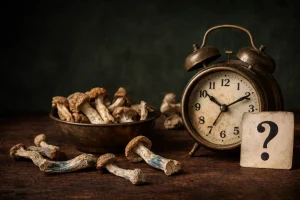
In decent conditions, dried mushrooms often keep for months, and sometimes close to a year, but quality and potency can change gradually. In contrast, fresh mushrooms have a much shorter shelf life and are more prone to spoilage due to their higher moisture content.
What shortens shelf life fast:
- moisture getting in
- frequent opening (humidity swings)
- warm, bright storage
- storing as powder
Dried psilocybin mushrooms can last up to 12 months when stored in a cool, dark place, while frozen psilocybin mushrooms can last for four years or more without losing potency.
What affects shelf life the most
1) Moisture
Even slight dampness raises the risk of mold. Too much moisture is especially problematic for fresh mushrooms, as it can quickly lead to spoilage and health risks. If they start bending instead of snapping, treat it seriously.
2) Oxygen + handling
More oxygen exposure = more oxidation. More handling = more bruising + chemistry you don’t want.
3) Heat + light
Light/heat can accelerate degradation; lab work supports that light exposure can substantially increase losses.
4) Whole vs powder
Powder has more surface area, so it tends to degrade faster; studies observing dried fungal powder found rapid changes across conditions early on.
Spoilage vs. potency loss: same mushrooms, different problems
When people ask “Do shrooms go bad?” they’re usually talking about two totally different things:
1) Spoilage (safety problem)
Spoilage means microbial contamination — mainly mold, bacteria, or yeast growth. This is the “don’t eat this” category.
What spoilage usually looks/smells/feels like:
-
Fuzzy or powdery growth (white/green/gray/black)
-
Slimy, damp, or mushy texture
-
Strong sour/musty/rotten odor
-
Wet clumps or condensation inside the container
-
Bugs/larvae/webbing
Why it happens: moisture + time + poor airflow/cleanliness. Dried mushrooms are safer than fresh, but if humidity gets in, spoilage can still happen.
Bottom line: if you suspect spoilage, discard. “Maybe it’s fine” is how people end up with a miserable stomach and an even worse afternoon.
2) Potency loss (quality + predictability problem)
Potency loss is chemical. The mushrooms might still be “clean” (no visible mold, normal smell), but the active compounds can degrade quietly over time.
What potency loss looks like:
-
Often… nothing obvious
-
Sometimes more browning/darkening or “tired” appearance (not always)
-
Effects feel weaker, shorter, or more inconsistent compared with prior batches
Why it happens: oxidation + light + heat + oxygen exposure + repeated opening of the container. Grinding/powdering can speed this up because it increases surface area exposed to oxygen. In lab work, storage conditions and processing (like cutting/handling) impacted measured compound levels, and light exposure tended to worsen losses.
Bottom line: potency loss isn’t usually dangerous on its own — it’s risky because it makes dosing unpredictable.
The quick decision guide: safe vs strong
Use this mental checklist:
“Is it safe?”
If you see mold, slime, pests, bad smell, or dampness → treat it as contaminated and discard.
“Is it strong?”
If it’s clean but old, frequently opened, stored warm/bright, or stored as powder → assume strength could be reduced or inconsistent.
Why people get confused: “It looks fine”
This is the key line worth keeping:
Spoilage is often visible. Potency loss is often invisible.
So a jar can look totally normal and still hit weaker than expected — or feel unpredictable — because chemistry doesn’t always leave a big visual clue.
Blue bruising explained (what it is and what it isn’t)
That blue staining you see after handling, cutting, or pressure isn’t “extra magic” showing up — it’s chemistry kicking off because the mushroom tissue got damaged.
What causes the blue color?
When the mushroom is injured, two enzymes start a chain reaction:
-
PsiP (a phosphatase) can remove the phosphate group from psilocybin, turning it into psilocin
-
PsiL (a laccase-like oxidase) then oxidizes psilocin, and those oxidized products link up into blue pigments (a mixture of oxidized psilocin “oligomers”).
So the blue is basically a visible “oxidation footprint” from that cascade — not a marker that something got stronger.
Does bruising mean “more potent”?
Not reliably. People often associate heavy bruising with potency because bruising is common in certain species/conditions — but the bruising reaction itself is tied to psilocin formation and oxidation, which is part of breakdown chemistry.
A more accurate way to phrase it:
-
Bruising can happen on potent mushrooms, but
-
Bruising isn’t proof of potency, and it’s definitely not proof of “extra potency.”
What makes bruising worse?
Bruising tends to get more intense when you combine:
-
More physical damage (slicing, crushing, lots of handling)
-
More oxygen exposure (open air, loosely sealed containers)
-
Moisture (rehydration/humidity reactivates activity and speeds spoilage risk)
-
Light/heat (generally accelerates degradation pathways)
Lab work on Psilocybe cubensis found that mechanical damage (like cutting/slicing) and storage conditions can affect measured compound levels, and they observed rapid blueing after cutting in their processing experiments.
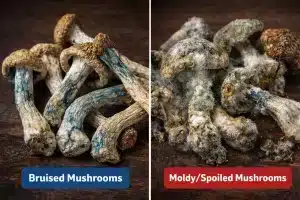
Blue bruising vs mold: how to tell the difference
This matters because bruising is usually just cosmetic chemistry, while mold is a safety issue.
Bruising usually looks like:
-
blue/blue-green staining within the tissue
-
smooth discoloration (not fuzzy)
-
appears where it was pressed, bent, or cut
Mold usually looks like:
-
fuzzy, powdery, or webby growth sitting on top of the surface
-
white/green/gray/black patches that can spread
-
often comes with musty/sour “wet basement” smell
If you see fuzz, wetness, slime, pests, or bad odor: treat it as spoiled and discard.
FAQ’s
Do dried mushrooms go bad?
Yes. Dried mushrooms can spoil if moisture gets in, leading to mold or bacterial contamination. They can also lose potency over time even if they look normal.
How can you tell if dried mushrooms have gone bad?
Common warning signs include fuzzy or powdery growth (mold), dampness or slime, a sour or musty odor, pests, or condensation inside the container. When in doubt, discard them.
What’s the difference between spoilage and potency loss?
Spoilage is a safety issue caused by mold or bacteria and is often visible (fuzz, slime, off smells). Potency loss is a quality issue caused by chemical degradation and can happen without obvious visual changes.
Does blue bruising mean mushrooms are moldy?
Not usually. Bruising is typically smooth discoloration inside the tissue after handling or pressure. Mold usually looks fuzzy or powdery on the surface and is often accompanied by dampness or off smells.
Can mushrooms lose potency without looking different?
Yes. Potency loss can be invisible because it’s driven by chemical degradation from oxygen, heat, light, and time. That’s why consistent dry, airtight, dark storage matters.
Science corner
A useful finding from Gotvaldová et al. (Drug Testing and Analysis) is that processing/handling and storage conditions can change measured tryptamine levels, and in their experiments fresh material stored at very low temperatures showed high degradation, while dried biomass stored dark at room temp showed comparatively low decay (in that study setup).
Final thoughts
If you control moisture, limit air exposure, avoid heat/light, and keep things clean, dried mushrooms tend to keep far longer than fresh. If anything looks damp, fuzzy, slimy, or smells wrong, don’t try to salvage it.

